

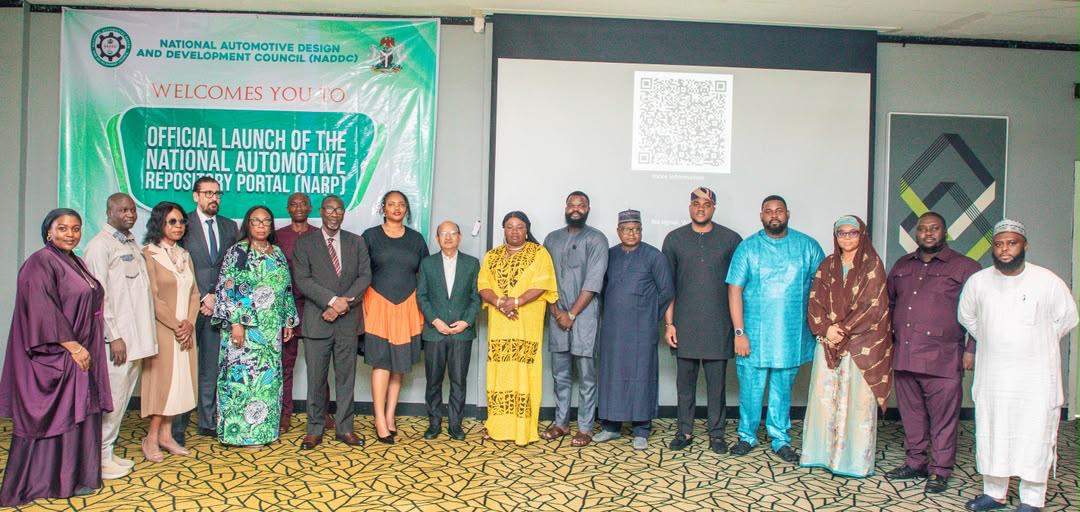
The National Automotive Design and Development Council (NADDC) on Wednesday, 8th July, 2026, officially launched the National Automotive Repository Portal (NARP), a landmark digital platform designed to strengthen regulation, improve data management, and enhance ease of doing business within Nigeria’s automotive industry.
Speaking at the event held at Radisson Blu hotel Ikeja Lagos, the Director-General, NADDC, Otunba Oluwemimo Joseph Osanipin ably represented by the Head of Policy, Planning and Statistics department of the Council, Mr. Nura Sidi described NARP as the digital backbone of Nigeria’s automotive ecosystem and a significant milestone in the implementation of the Nigerian Automotive Industry Development Plan (NAIDP 2023–2033). He noted that the platform was developed to address the long-standing challenge of fragmented industry data by providing a centralized digital infrastructure for real-time information, regulatory oversight, and compliance management.
He explained that NARP will digitalize and streamline corporate licensing processes for vehicle assemblers, eliminate manual delays, and provide real-time insights into domestic vehicle assembly capacity, supply trends, and market pricing. According to him, the availability of reliable industry data will support evidence-based policy formulation, attract foreign direct investment, and strengthen Nigeria’s automotive value chain.
Further stating that the portal establishes an automated inter-agency digital infrastructure linking key regulatory stakeholders to facilitate the verification of vehicle technical information, validate genuine assembly components, and protect the local automotive industry from the influx of substandard products. He disclosed that several vehicle assemblers have already been successfully onboarded onto the platform, demonstrating the private sector’s readiness to embrace digital transformation.
He expressed appreciation to the Honourable Minister of Industry, Trade and Investment for providing strategic policy leadership and commended local vehicle assemblers for their continued investments and commitment to the development of Nigeria’s automotive industry.
Declaring the platform officially launched, the Director-General, through his representative, called on all stakeholders to utilize NARP as the official rule-based compliance platform for building an inclusive, transparent, standards-driven, and globally competitive automotive industry.
He explained that the platform was developed to eliminate operational bottlenecks associated with fragmented data collection and manual compliance processes. According to him, NARP serves as a centralized compliance engine that digitalizes assembler licensing, automates factory site evaluations, monitors technical inspections in real time, and maintains a secure digital record of every registered vehicle through its unique Vehicle Identification Number (VIN).
Nura Sidi emphasized that beyond being an administrative platform, NARP is strategic public infrastructure designed to empower local vehicle assemblers by simplifying regulatory procedures, improving transparency, reducing bureaucratic bottlenecks, and significantly enhancing ease of doing business within the sector. He encouraged stakeholders to actively participate in the onboarding process and technical demonstrations, noting that the platform marks the beginning of a new era of digital excellence for Nigeria’s automotive industry.
The NARP launch is a landmark achievement in Nigeria’s automotive journey geared towards building a structured, technology – driven, and globally competitive automotive sector. The event attracted representatives from various licensed vehicle assembly plants across the country, alongside key stakeholders in the automotive industry.
The program underscores NADDC’s commitment to leveraging digital technology to strengthen regulation, promote transparency, support local manufacturing, improve investment confidence, and accelerate the sustainable growth of Nigeria’s automotive industry.