

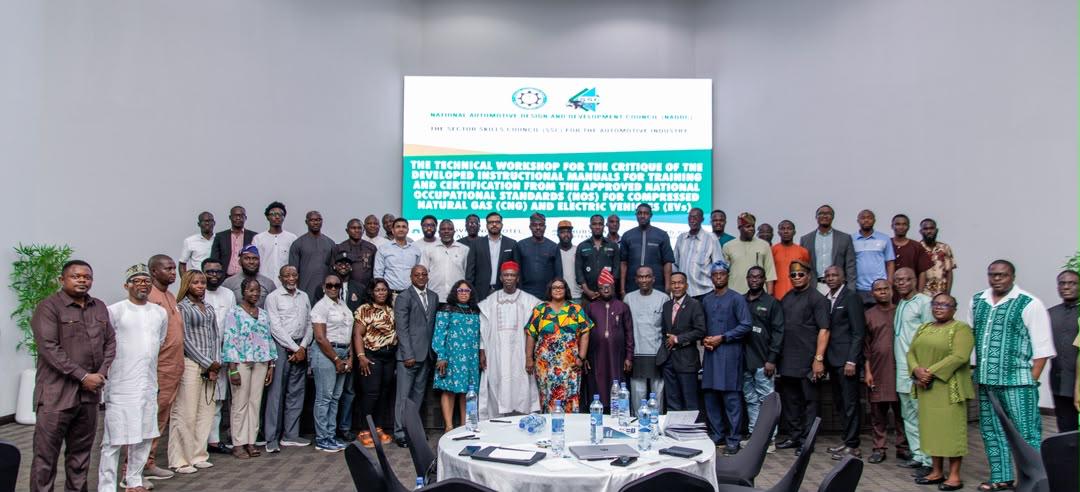
In a strategic move to strengthen automotive skills development in Nigeria, the National Automotive Design and Development Council (NADDC) organised a technical workshop on September 24, 2026, at Providence Hotel, Ikeja, Lagos, to critique and validate draft instructional manuals developed from the approved National Occupational Standards (NOS) for Compressed Natural Gas (CNG) vehicle conversion and Electric Vehicle (EV) maintenance.
The workshop brought together technical experts, industry practitioners, trainers, assessors, academics, members of the Automotive Sector Skills Council and other stakeholders to critically review the manuals and ensure that they meet national requirements and international best practices. The exercise is aimed at producing standardized training materials that will promote quality and consistency in the training and certification of automotive technicians.
Speaking at the workshop, the Director General/CEO of NADDC, Otunba Oluwemimo Joseph Osanipin, emphasized the importance of ensuring that the instructional manuals are technically accurate, practical, competency-based, industry-relevant and responsive to Nigeria’s evolving automotive environment. He also stressed the need for strong occupational health and safety provisions, particularly in the areas of high-pressure CNG systems, high-voltage EV systems, batteries, charging infrastructure, diagnostics and maintenance.
Osanipin who was ably represented by the Director, Industrial Infrastructure Department (IID), Mrs. Joke Onireti, explained that the objective of the validation exercise is to ensure that the developed materials conform to international best practices. She noted that after the necessary amendments are made based on stakeholders’ contributions, the document will be forwarded to the National Board for Technical Education (NBTE) and the Industrial Training Fund (ITF) for the necessary approvals, after which it can become an official training document for the Nigerian automotive industry.
Presenting the overview of the instructional manual, the President of the Automotive Sector Skills Council, Engineer Best Nnodim, described the exercise as a critical workshop, explaining that NADDC management had mandated the Sector Skills Council to develop training manuals that would guide training across designated centres. He noted that the National Occupational Standards had earlier been developed as the foundation or curriculum for the training, while the instructional manuals were developed from the standards to guide both trainers and trainees.
Engineer Nnodim further explained that the validation process was deliberately designed to obtain wider stakeholder input. The exercise is being conducted in phases, beginning with the Southern region, comprising stakeholders from the South-East, South-South and South-West. A subsequent session will be held in Kano for stakeholders from the northern regions. Observations from the various zones will thereafter be harmonized by a smaller committee to produce a nationally acceptable document in line with the established government procedure for developing national training materials.
The immediate past President of the Sector Skills Council, Engineer Udeh Francis, stated that the workshop focuses on the critique and validation of instructional materials developed for the training of technicians in CNG vehicle conversion and EV maintenance. He explained that the exercise is a follow-up to the development of the National Occupational Standards for both areas, which provide the foundation for training personnel in these emerging areas of the automotive industry.
He added that the development and validation of the instructional materials are essential to standardizing training and maintaining quality across the sector. According to him, the participation of experts from academia, industry and technical practice would help ensure that the materials conform to international best practices and support consistent, high-quality training outcomes in both CNG and electric vehicle technologies.
The workshop therefore represents an important step towards strengthening Nigeria’s automotive skills development framework, ensuring that technicians and other industry practitioners receive standardized, practical and industry-relevant training capable of supporting the country’s transition to emerging automotive technologies.