


By Okeme Faith Chubiyojo
Nigeria’s labour market is under pressure, even as the country remains one of Africa’s largest economies and its population continues to grow. The challenge is not simply the number of people without jobs. It is also the shortage of secure, productive and reasonably paid work.
The National Bureau of Statistics’ revised labour-force survey recorded an unemployment rate of 5.3 percent in the first quarter of 2024. That figure should not be read in isolation. Many Nigerians who are counted as employed work in informal, unstable or low-paying jobs, while others do not work enough hours to support themselves or their families. The World Bank estimates that about 3.5 million people enter Nigeria’s labour force every year, placing enormous pressure on an economy that is not creating quality jobs quickly enough.
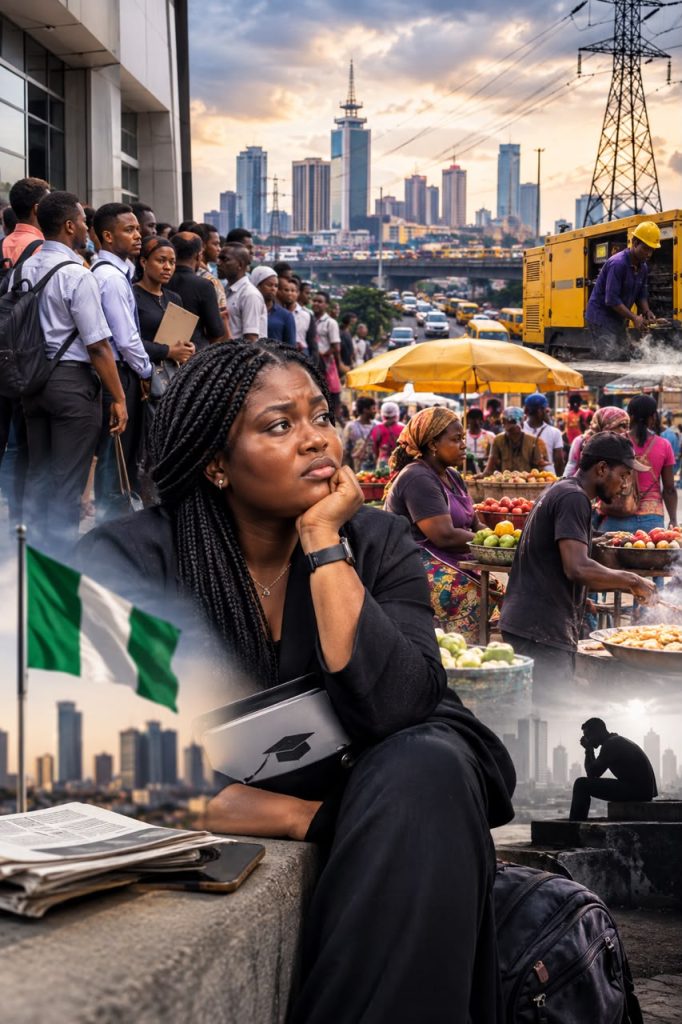
Young people are particularly exposed to this reality, with graduates flooding a labour market with too few formal openings, while many others are forced to create work for themselves in an informal economy with limited access to credit, infrastructure and social protection. Women also face significant barriers, including unequal access to finance, care responsibilities and fewer opportunities in higher-paying sectors.
Small businesses should be part of the solution. They employ millions of Nigerians and keep local economies moving. Yet many struggles with unreliable electricity, high operating costs, overlapping taxes and complicated regulations. Nigeria is not short of people willing to work. It is short of an environment in which businesses can survive, expand and employ more people.The consequences of inaction are no longer distant. High youth unemployment fuels migration, crime, and political unrest. Idle hands in a hungry economy do not stay idle for long, they migrate through the desert, join armed groups, or lose faith in the state entirely. A nation that cannot employ its young people is not merely facing an economic problem; it is sitting on a social time bomb.
The first and most urgent barrier is electricity, no serious job-creation strategy can ignore electricity. Small and medium-sized businesses cannot compete when they must rely on petrol or diesel generators to keep their doors open. The cost of fuel, maintenance and repairs reduces the money available for wages, expansion and new equipment.
For years, power has been treated mainly as an infrastructure problem. It is also a labour-market problem. When a bakery, salon, workshop, restaurant or small factory spends a large share of its income generating electricity, it has less room to hire, train workers or lower prices.
Nigeria has taken steps towards a more decentralised electricity system. Constitutional changes in 2023 and the Electricity Act 2023 gave states a clearer role in legislating for and regulating electricity generation, transmission and distribution within their territories. However, the reform will only make a difference if states build credible regulatory systems, establish transparent tariffs and attract serious private investment. As of May 2026, 15 states had transitioned to regulating their own electricity markets.
The federal and state governments should now focus on implementation. That means supporting independent power projects, expanding mini-grids where extending the national grid is impractical, improving access to finance and protecting consumers from arbitrary pricing. Rwanda offers a useful example of what sustained investment can achieve; its electricity-access rate rose from 18 percent in 2012 to 84 percent by June 2025 through a combination of grid expansion and off-grid solutions.
Nigeria does not need to copy Rwanda, but it can learn from the principle behind the progress, electricity access improves when grid and off-grid solutions are planned together and backed by consistent policy.
Reliable power would not solve every problem facing small businesses. It would, however, reduce one of their most damaging costs and give viable firms a better chance to grow.
The second major obstacle is the difficulty of starting and running a business. Entrepreneurs often have to deal with company registration, local permits, taxes and levies imposed by different levels of government, as well as overlapping rules enforced by multiple agencies.
This complexity encourages some businesses to remain informal. Informality may help a business avoid immediate compliance costs, but it also limits access to loans, contracts, insurance and legal protection. It also leaves workers more vulnerable because informal jobs often come without written contracts, stable earnings or social security.
The answer is not to remove every regulation. Businesses and workers need rules that protect property, consumers, employees and the public interest. The priority should be to eliminate duplication, clarify responsibilities and make compliance affordable.
Nigeria should work towards a coordinated digital system through which businesses can complete registration, obtain relevant permits and meet tax obligations without repeatedly visiting different offices. Each level of government should clearly state what it is entitled to collect, provide a single payment channel and publish a transparent schedule of fees.
Nigeria’s employment crisis is not only an economic concern. When young people cannot find decent work, they are more likely to consider risky migration routes, disengage from public institutions or become vulnerable to criminal and extremist recruitment. Unemployment does not automatically cause crime or unrest, but prolonged joblessness, poverty and insecurity can deepen social frustration.
The World Bank has identified weak job creation, limited entrepreneurial opportunities and rising emigration as continuing concerns for Nigeria. It also points to gaps in electricity, transport and logistics as constraints on productivity and domestic trade.
The country therefore needs more than slogans about empowering young people. It needs practical reforms that make it easier for businesses to remain open, invest and hire. Reliable electricity, simpler regulation, access to finance, better skills training and improved security must work together.
Stable power and a more predictable business environment will not create jobs overnight. They will, however, give employers a better chance to create and retain them. They can help businesses that are struggling to survive, encourage informal firms to formalise and make it easier for new enterprises to enter the market.
Nigeria has already announced many of the policies required to move in this direction. The real test is implementation. The country’s young population should not have to choose between leaving home, accepting insecure work or losing faith in the future. For millions of Nigerians, decent work is not an abstract economic target. It is the difference between dignity and dependence.

Disclaimer: The views and opinions expressed by contributors, authors, guests, or users are their own and do not necessarily reflect the official policy, position, or opinions of Social Plus Africa Communications Ltd. Any content provided by individuals is intended for informational purposes only and should not be interpreted as representing the views of Social Plus Africa Communications Ltd or its affiliates.